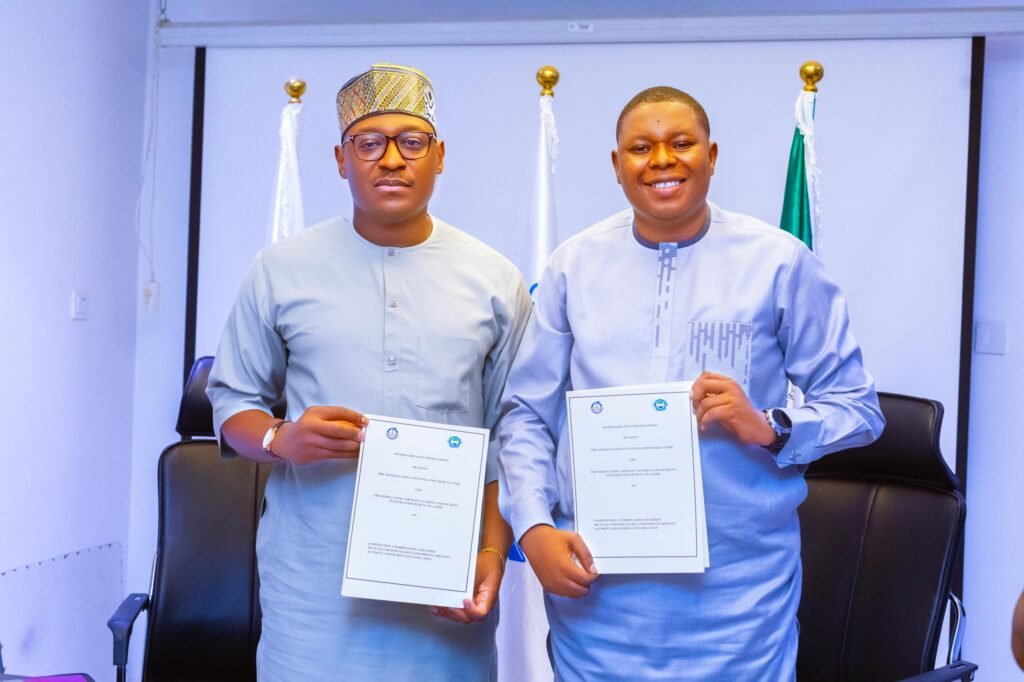
The Nigerian Safety Investigation Bureau has signed a cooperation agreement with the Sierra Leone Aircraft Accident and Incident Investigation Bureau to strengthen joint aircraft accident investigations, data exchange, and technical training, in a move that reflects Director General Captain Alex Badeh Jr’s focus on building stronger regional safety systems.
The Memorandum of Understanding (MoU), signed at the NSIB Headquarters in Abuja, enables both organisations to conduct joint investigations, exchange expertise, and support each other in improving aviation safety outcomes across their jurisdictions. The agreement also provides for technical assistance, training, verification support, and structured collaboration in air accident investigation.
At the core of the MoU is a framework that supports training programmes, secondment of investigators, and the sharing of safety data and technical knowledge. It extends to flight recorder analysis, access to investigative equipment, and participation in investigations as accredited representatives in line with international aviation standards. The partnership also provides for the deployment of expert teams, including flight recorder specialists and forensic resource personnel, with the requesting party responsible for travel, transport, subsistence, and accommodation costs.
Director General of NSIB, Captain Alex Badeh Jr, stated that the partnership reflects a shared commitment to strengthening investigative capacity and improving safety across the region. He noted that cooperation between Nigeria and Sierra Leone will strengthen institutional systems, improve response time, enhance precision in findings, and maintain focus on preventing future occurrences.
He added that the agreement reinforces both organisations’ commitment to upholding the International Civil Aviation Organization (ICAO) Standards and Recommended Practices contained in Annex 13 of the Chicago Convention on International Civil Aviation, which emphasises that the objective of accident investigation is the prevention of future occurrences, not the apportionment of blame or determination of liability.
A key component of the partnership is human capacity development, with provisions for the exchange of investigators to attend specialised training programmes and observe live investigations, strengthening technical competence and deepening understanding of investigative procedures.
Commissioner of SL-AAIIB, Engr. Olubunmi Wellington, described the agreement as a significant step toward strengthening investigative systems across the region. He stated that the partnership provides access to advanced training, improved investigative methods, and shared experience, while also acknowledging NSIB’s continued support in establishing and developing Sierra Leone’s accident investigation framework.
He praised Captain Alex Badeh Jr. for sustaining the partnership initiated by his predecessor, Engr. Akin Olateru, noting his principled and collaborative approach and commitment to strengthening regional safety systems. He further described Nigeria as an elder brother in the region, emphasising that NSIB’s support has been instrumental in building a strong foundation for Sierra Leone’s aviation safety system.
Prior to the MoU, NSIB deployed a fact-finding team to Sierra Leone ahead of an international audit in 2023, assessing gaps and providing guidance on strengthening institutional capacity. Following the fact-finding mission, both agencies sustained collaboration through virtual meetings, technical consultations, and training programmes, contributing to measurable improvements in Sierra Leone’s aviation safety oversight. According to Engr. Wellington, this intervention helped increase Sierra Leone’s Effective Implementation score from 18 percent to 72 percent after reforms, including amendments to accident investigation legislation.
Both organisations reaffirmed their commitment as members of the Banjul Accord Group (BAG) to support one another in air accident investigation activities and strengthen cooperation aimed at improving aviation safety across West Africa.
The partnership comes at a time when aviation activity across the region continues to groaw, placing greater demand on safety systems and investigative capacity. By combining resources and expertise, both agencies are better positioned to respond to aircraft accidents and serious incidents, conduct thorough investigations, and implement safety recommendations that contribute to safer skies across West Africa.